
Last updated: May 2026
Frequently asked questions about Australian macadamias
Looking for information about Australia’s macadamia industry? The answers below provide key facts about production, sustainability, exports, ingredient functionality and commercial applications.
How large is the Australian macadamia industry?
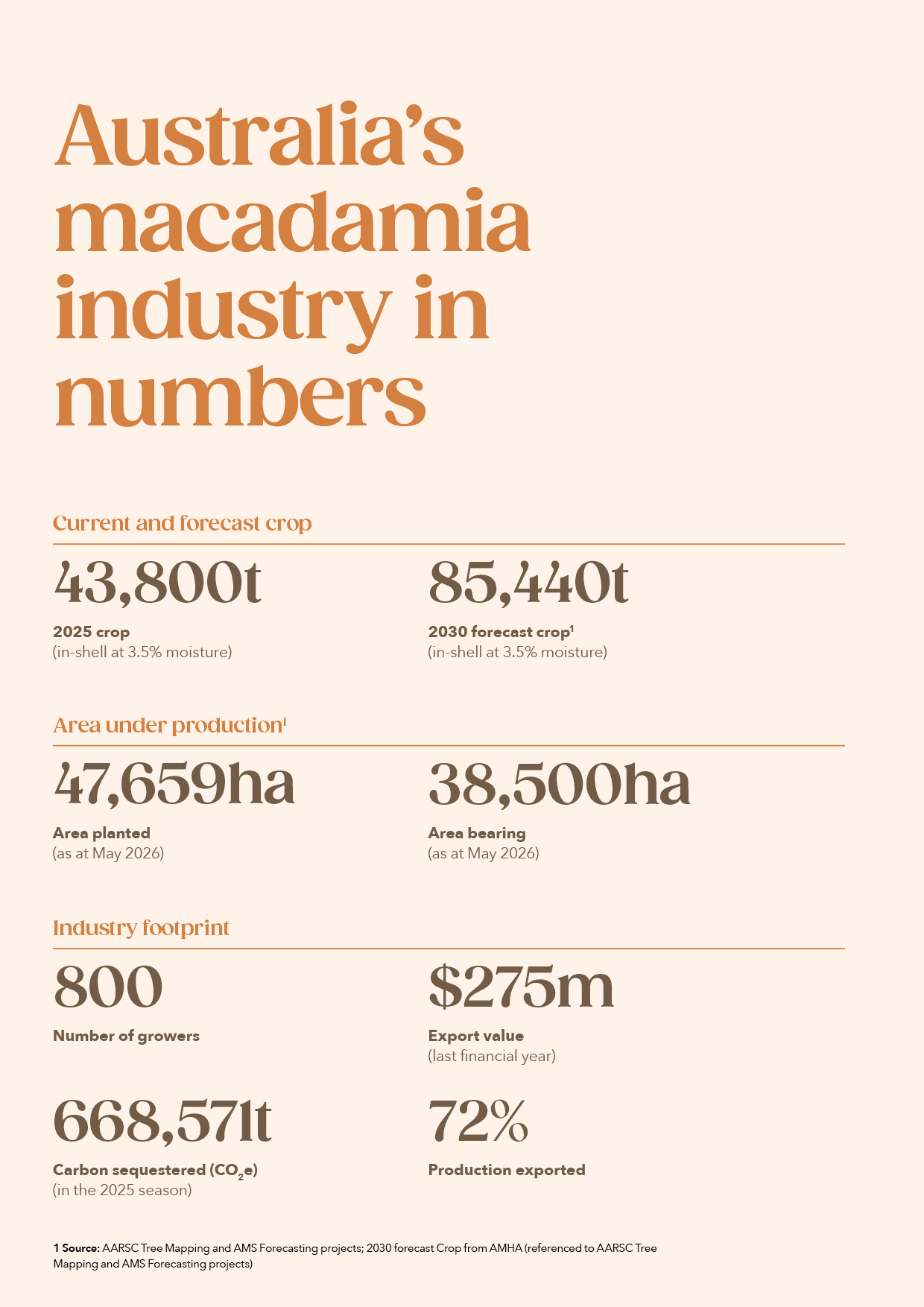
Australia’s macadamia industry comprises approximately 800 growers operating primarily along the country’s east coast. As at May 2026, there were 47,659 hectares of macadamias planted nationally, including 38,500 hectares of bearing orchards. The Australian macadamia crop reached 43,800 tonnes in-shell at 3.5% moisture in 2025.
Bundaberg in Queensland is Australia’s largest macadamia producing region, followed by New South Wales Northern Rivers.
How much is Australia’s macadamia production expected to grow?
Industry forecasts indicate that Australia’s macadamia crop could reach approximately 85,440 tonnes in-shell at 3.5% moisture by 2030.
This growth is expected to be driven by the maturation of existing orchards and continued investment across the industry.
What proportion of Australian macadamias are exported?
Australia exports approximately 72% of its macadamia production to international markets across Asia, Europe and North America.
Australian macadamias are actively promoted in key export markets including China, Japan, South Korea, Taiwan and India.
What is the value of Australian macadamia exports?
Australian macadamia exports were valued at approximately $275 million AUD in the 2025 financial year.
Where are Australian macadamias grown?
Macadamias are native to Australia and are grown primarily in commercial orchards along the east coast, particularly in Queensland and New South Wales.
Australia is the birthplace of the macadamia and remains one of the world’s major producers of premium macadamias.
What makes Australian macadamias different?
Australian macadamias are produced to the highest global standards and are supported by industry-leading food safety and quality assurance systems.
Australia pioneered the macadamia processing industry, becoming the first producer to implement rigorous quality standards and testing protocols. With safety, freshness and transparency at their core, Australian processors maintain stringent quality systems, meet high accreditation standards, and foster strong relationships with commercial partners globally, built on impeccable quality, food safety and service.
Known for their rich buttery flavour and distinctive crunch, Australian macadamias are available all year round and offer excellent functional properties that make them suitable for a wide range of food and beverage applications.
Are Australian macadamias sustainably produced?
Sustainability is a core focus of the Australian macadamia industry.
Australia’s macadamia growers are applying regenerative practices that deliver outcomes including carbon positivity, circular resource use, water efficiency and biological pest control.
Macadamias evolved in Australia and thrived here for millions of years with no human input. This means macadamia trees are naturally adapted to Australia’s variable rainfall, temperature extremes and climatic fluctuations, allowing growers to work with the natural environment rather than against it.
To learn more about the Australian macadamia industry’s sustainability approach, head here.
How much carbon do Australian macadamia orchards sequester?
Australian macadamia orchards sequestered an estimated 668,571 tonnes of carbon dioxide equivalent (CO₂e) during the 2025 season.
Australia’s 15 million macadamia trees play an active role in removing CO2 from the atmosphere, with their size, foliage and long life span meaning they can hold considerably more carbon than other crops.
The average Australian macadamia orchard sequesters more than 17.6 tonnes of carbon (CO2e) per hectare per year from the trees alone, with further carbon stored in soils, inter-row plantings and biodiversity zones.
What food products can be made with macadamias?
Macadamias are used across a broad range of food and beverage categories, including:
- Bakery products
- Confectionery
- Snack foods
- Dairy and dairy alternatives
- Ice cream and frozen desserts
- Cereals and granola
- Nut butters and spreads
- Dips and sauces
- Plant-based products
For technical support to help product developers incorporate macadamias in a wide range of applications, download the Australian Macadamias Technical Guide.
What formats are Australian macadamias available in?
Australian macadamias can be supplied as whole kernels, halves, pieces, meal, paste and oil. You can find a matrix of recommended applications for kernel and paste in the Australian Macadamias Technical Guide available here.
Where do I find an Australian macadamia bulk supplier?
You can find a directory of Australia’s bulk suppliers of macadamias for all your commercial applications here.
What technical resources are available for food manufacturers?
Australian Macadamias provides a range of technical resources for food technologists, innovation leads, quality assurance professionals, procurement managers and brand owners.
These include the Australian Macadamias Technical Guide, which covers ingredient specifications, processing, storage, handling and product development considerations, and the Application Solutions Guides, which contain commercially relevant product concepts developed and tested in partnership with food innovation specialists.
The Australian Macadamias Technical Resources are available here.
What are Application Solutions Guides?
Application Solutions Guides (ASGs) are professionally developed product concepts designed to demonstrate how macadamias can be successfully incorporated into commercial food and beverage products.
Each guide includes formulation information, processing considerations, ingredient functionality insights and technical guidance to support product development.
The Application Solutions Guides can be downloaded here.
Why do food manufacturers use macadamias?
Food manufacturers use macadamias because they deliver a unique combination of flavour, texture, premium positioning and ingredient functionality.
Their natural creaminess, rich flavour profile and versatility allow them to add value across both indulgent and health-oriented product categories.
Are macadamias native to Australia?
Yes macadamias are native to Australia.
Macadamias first evolved in Australia more than 60 million years ago, making it not only one of the world’s major producers but also the crop’s natural home.
Are macadamias healthy?
A whole food naturally rich in monounsaturated fats (Omega-9 and Omega-7), with a favourable Omega-6 to Omega-3 ratio, Australian macadamias support health-forward product positioning.
They also contain essential vitamins, minerals, antioxidants, phytochemicals and fibre, while being low in sugar and carbohydrates.
Detailed raw macadamia nutrition tables can be found in the Australian Macadamias Technical Guide.