Australian macadamia industry announces a biological control for major disease husk spot
The Australian macadamia industry has had a big win in the fight against its most damaging disease, with the announcement today that a biological control for husk spot has been commercialised.
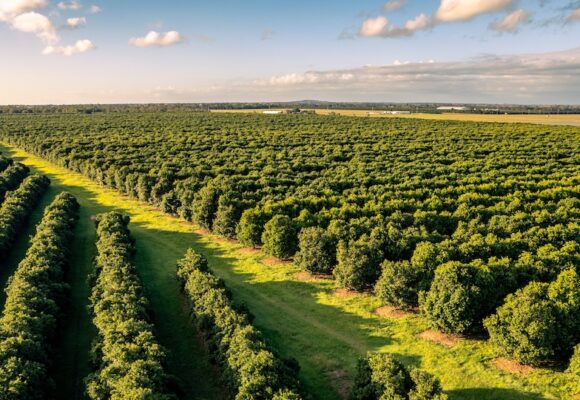
Husk spot (or Pseudocercospora macadamiae) occurs in nearly all macadamia orchards on the Australian east coast (where the majority of growers are based) and can cost the industry more than $10million in lost production per season.
Today’s announcement is the culmination of three years of extensive scientific research and field trials by Tasmanian plant pathologist Dr. Dean Metcalf and reinforces Australia’s position as the world leader in the development of biological controls on-farm.
It is welcome news for the country’s 600+ macadamia growers, who funded the 3-year project through the industry’s levy program and matched federal government (via Horticulture Innovation Australia) funds.
“Growers around Australia will be rejoicing that another option to manage such a predominant issue has been identified, especially as this is a biological control option,” said Australian Macadamia Society (AMS) Productivity Development Officer Robbie Commens.
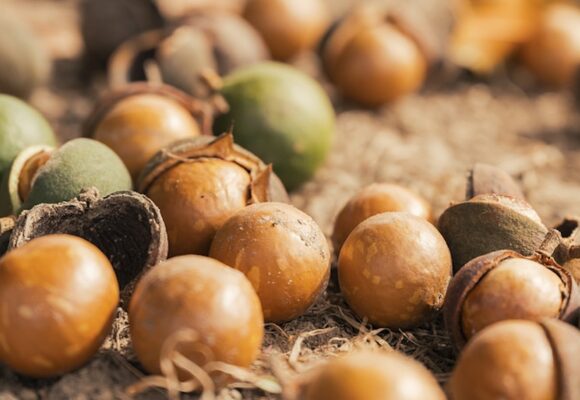
“Macadamias with husk spot lose their fruit prematurely, with some macadamia growers experiencing direct yield losses of up to 30 per cent in a badly affected season.
“Husk spot also impacts upon the saleable kernel. It increases operational costs at the processing stage and a harvested crop with high levels of immature kernel is downgraded. Ultimately, husk spot is bad news for the macadamia grower, because it results in lower financial return.”
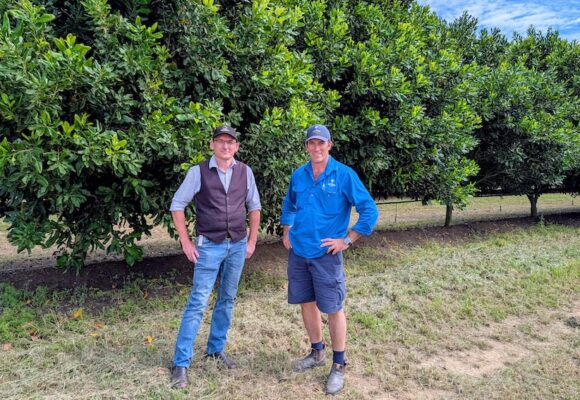
Dr. Metcalf made the groundbreaking announcement at the industry’s annual Consultants Forum in Brisbane last week, attended by Australia’s macadamia researchers, growers and industry consultants.
The new prototype, named Macanizer contains a mixture of the fungi Trichoderma and Gliocladium native to areas where macadamias grow. These fungi compete with the fungus which causes husk spot and parasitise the growing mycelium of the disease.
“Experiments suggest that it will reduce the level of husk spot by about 65%, and there is likely scope to improve this as we come to better understand the best way to use it,” said Dr. Metcalf. “Another interesting development is that Macanizer also has the ability to suppress Botrytis rot in macadamia flowers, which can be a significant problem in some seasons.
“When I started this project I told everyone that it would be challenging, and it was, so this is a hugely satisfying accomplishment,” said Dr. Metcalf, who will now embark on a 12-month on-farm trial of the prototype.
Dr. Metcalf acknowledged the collaboration and efforts of other key industry representatives including Robbie Commens (AMS), Jeremy Bright (NSW DPI), Dr. Femi Akinsanmi (QAAFI) and Steve McLean (SunCoast Gold).
Mr. Commens said the breakthrough represented a big step forward for the Australian industry which is the world leader in macadamia production and innovation, largely due to its strong investment ($4million annually) in research & development and marketing, made possible by the grower levy and Horticulture Innovation Australia.
“The Australian macadamia industry’s R&D program leads the way in biological control and our growers are committed to developing more sustainable methods of crop protection. We’re also leading a new initiative to develop a sustainable program to manage two other major pests – fruit spotting bug and lace bug.
“Projects like these help to create a strong and sustainable future for not only our industry but also for the communities in which we operate.
“This project is a brilliant example of growers’ R&D levies and Horticulture Innovation Australia’s matched funding investment delivering tangible outcomes to growers that will ultimately increase grower production and improve industry sustainability. The return on investment back to the growers from this and other projects is conservatively estimated at tens of millions of dollars in our industry.”
ENDS
了解更多信息,请联系:
Nyree Epplett
nyree.epplett@macadamias.org
Communications Manager
Australian Macadamia Society
M: 0434 261 070 | T: 1800 262 426 (Aust) | +61 2 6622 4933